Neurodiversity And UX: Practical Guides
Practical guidelines, tools, and resources to understand and design for dyslexia, dyscalculia, autism, and ADHD — because neurodivergent needs aren't an edge case.
Neurodivergent needs are often treated as an edge case — something that doesn't quite fit into the common user journeys and flows we design for. Neurodiversity tends to get overlooked early in the process, and tackled later, if there's enough time left for it at all.
But people aren't edge cases. Every person is simply a different person, performing tasks and navigating the web in their own way. So how do we design better, more inclusive experiences that cater to different needs — and, ultimately, benefit everyone? Let's take a closer look.
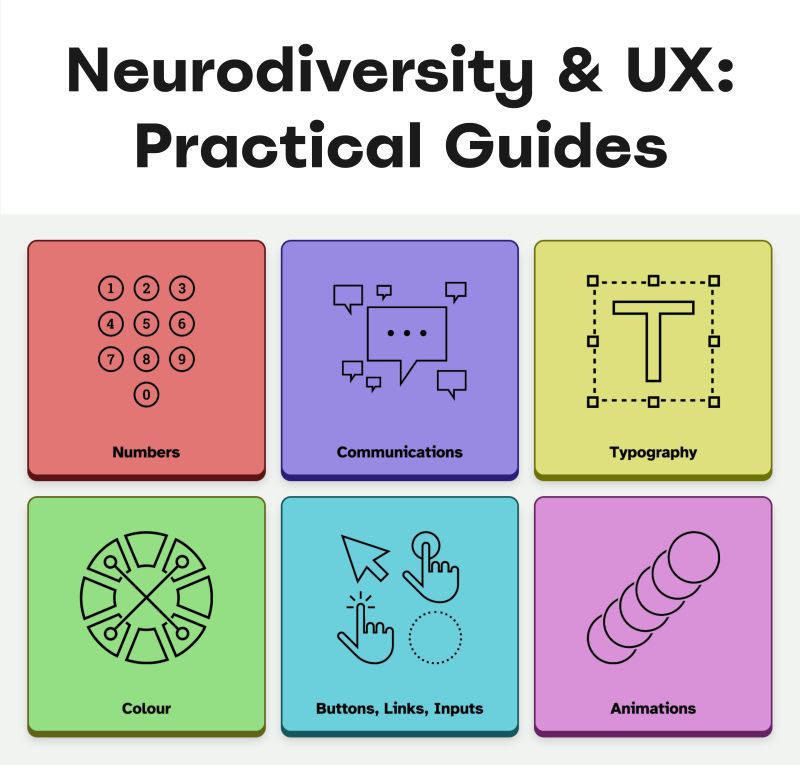
By considering neurodiversity early in the design process, we can create better experiences for everyone. Image source: Neurodiversity Design System.
Neurodiversity Or Neurodivergent? #
There's quite a bit of confusion around both terms. Neurodiversity sees differences in how people think and experience the world as natural variation, not as deficits. It distinguishes between two groups:
- Neurotypical people experience the world in a "typical", broadly expected way.
- Neurodivergent people experience the world differently — for example, people with ADHD, dyslexia, dyscalculia, synesthesia, or hyperlexia.
According to various sources, somewhere between 15–40% of the population has neurodivergent traits. These traits can be innate (autism, for instance) or acquired (such as trauma), but they always exist on a spectrum, and vary a great deal from person to person. A person with autism, for example, is not "neurodiverse" — they are neurodivergent. Neurodiversity describes the diversity of minds across a whole population; neurodivergent describes an individual whose mind diverges from the "typical" norm.
One of the main strengths of neurodivergent people is how imaginative and creative they are, often coming up with out-of-the-box ideas quickly — paired with exceptional levels of attention, strong long-term memory, a unique perspective, unbeatable accuracy, and a strong sense of justice and fairness.
Being different in a world that, to some degree, still doesn't accommodate these differences is exhausting. So it's no surprise that neurodivergent people often bring along determination, resilience, and high levels of empathy, too.
Design With People, Not For Them #
As designers, we often see ourselves as path-makers — building reliable paths for people to reach their goals comfortably, without being blocked, confused, or locked out along the way.
That means respecting the simple fact that people's needs, tasks, and user journeys are all different — and that they evolve over time. Most importantly, it means considering them very early in the process, not bolting them on once the "real" design work is already done.
Better accessibility is better for everyone. Rather than making decisions that later need to be reverted or refined just to become compliant, we can bring a diverse group of people into the process from the start — people with accessibility needs, people with neurodivergent traits, frequent and infrequent users, experts, newcomers — and design with them, rather than for them.
Neurodiversity & Inclusive Design Resources #
A wonderful resource that helps us design for cognitive accessibility is Stéphanie Walter's Neurodiversity and UX toolkit. It includes practical guidelines, tools, and resources to better understand and design for dyslexia, dyscalculia, autism, and ADHD.
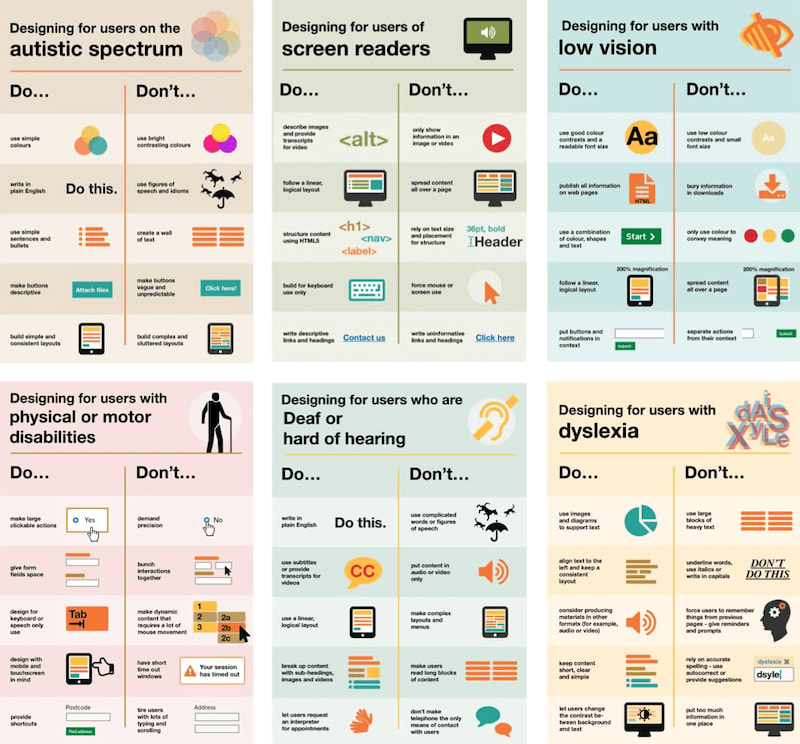
GOV.UK's posters with accessibility dos and don'ts are just one of the many useful resources you'll find in Stéphanie Walter's collection.
Another fantastic resource is Will Soward's Neurodiversity Design System. It combines neurodiversity and user experience design into a set of design standards and principles you can use to design more accessible learning interfaces.
Beyond these two toolkits, it's worth building a habit of looking at specific conditions one at a time, rather than treating "neurodiversity" as a single, interchangeable category. ADHD, autism, dyslexia, and dyscalculia each come with their own patterns of strengths and friction points, even though they frequently overlap in the same person. A good starting point is a short, focused summary per condition — something you can skim in a few minutes and refer back to whenever a related design decision comes up, covering topics such as ADHD, autism, dyscalculia, dyslexia, legibility, mental health, motivation, older adults, screen readers, and teenagers, among others.
Useful Resources #
- Neurodiversity And UX: Essential Resources For Cognitive Accessibility, by Stéphanie Walter
- Neurodiversity Design System, by Will Soward
- Dos And Don'ts On Designing For Accessibility, by GOV.UK