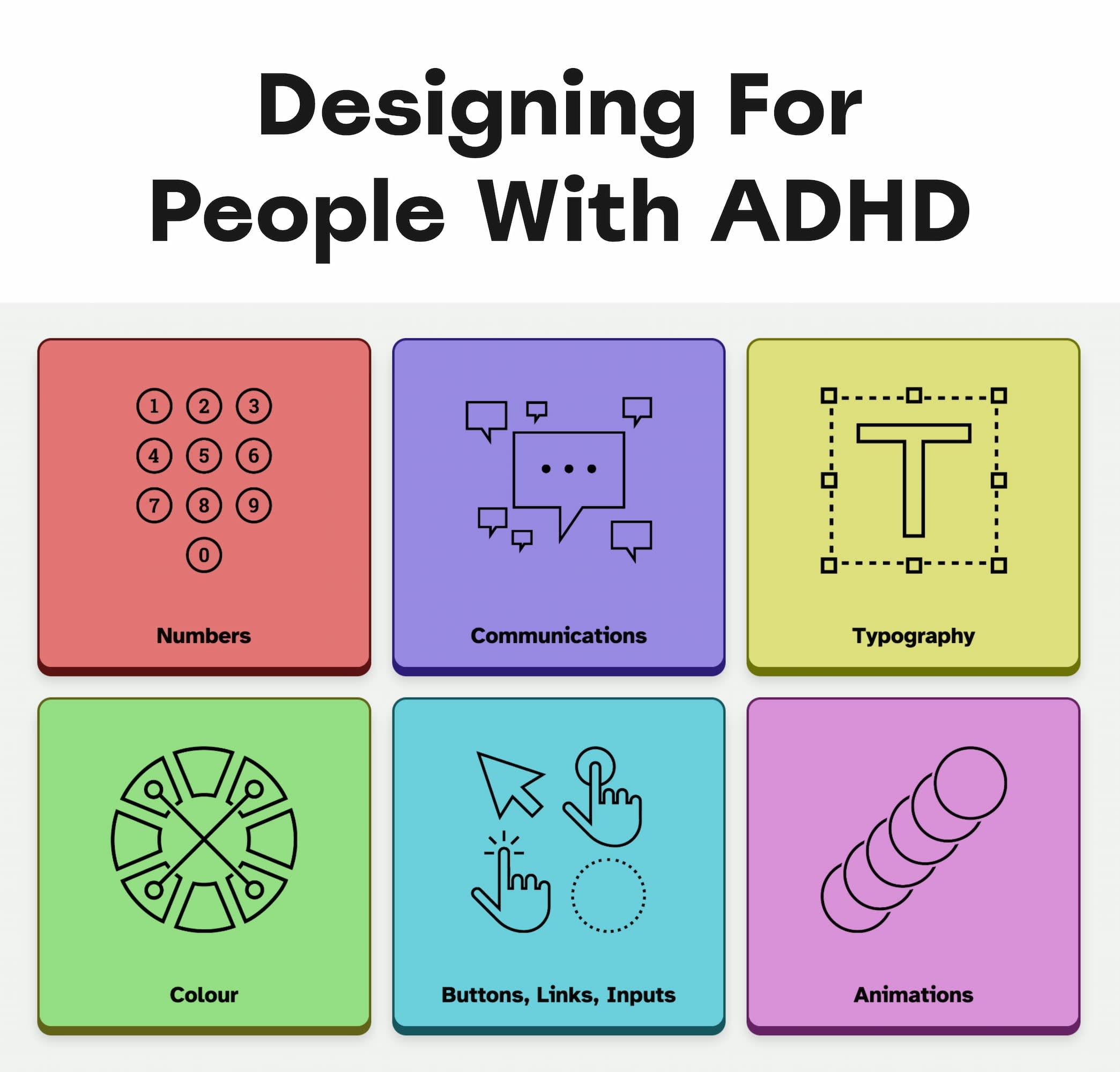
Designing For People With ADHD
A practical guide on how ADHD shows itself, and design patterns to help neurodivergent users accomplish their tasks.
Different people think and experience the world differently. Some people perceive it in a "typical", expected way. Others experience a vastly more confusing, challenging and noisy world — e.g. people with ADHD, dyslexia or dyscalculia.
After all these years, there are still myths and confusion around ADHD. It's often perceived as a temporary condition that passes by over time, or that it's a sign of poor discipline or willpower.
Neither is actually true. So let's see what ADHD means, and how to design for people who experience ADHD daily — and (as it's always the case with accessibility) benefit everyone else, too.
The Neurodiversity Design System — design principles and learner personas informed by the real needs of neurodiverse users.
What Is ADHD? #
ADHD (Attention-Deficit Hyperactivity Disorder) affects 5% of people globally — though the real number might be higher, as many people are diagnosed late or not at all. It's not a condition that passes over time — people don't outgrow ADHD. If it affects around 5% of children, it affects around 5% of adults, too. Over time, adults learn to better cope with ADHD.
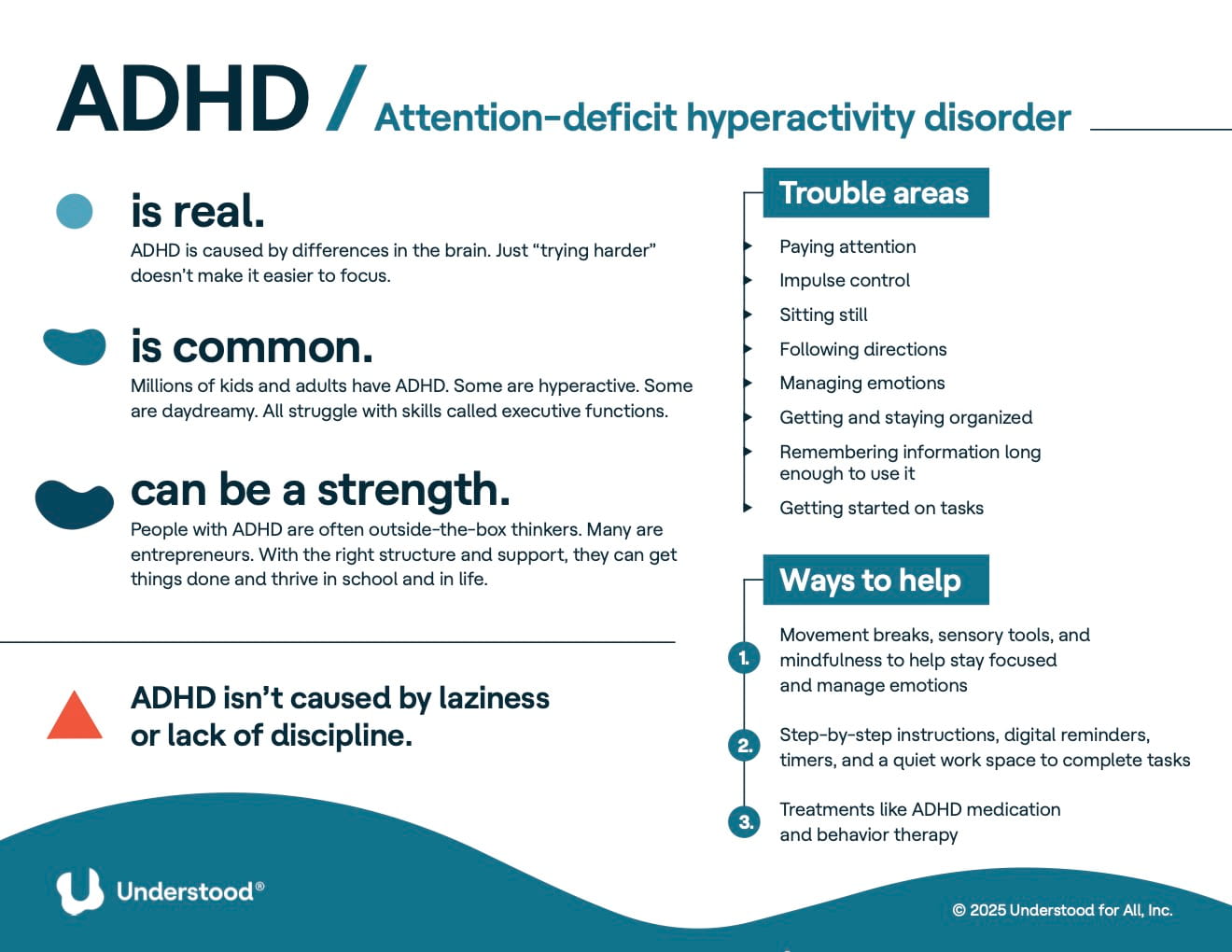
ADHD Fact Sheet, by Understood.org. PDF.
ADHD typically shows in forgetfulness, time-blindness, impulsivity and hyperactivity. People with ADHD have trouble sitting still, racing thoughts and a hyperactive mind. It's hard to handle unstructured situations that need reflection, and it's challenging to listen to others while holding a thought.
It's a neurological condition caused by differences in how the brain develops and functions. The brain simply takes longer to develop in the areas that handle focus, planning, and self-regulation. For example, children with ADHD may act 1–3 years younger than their peers because of it.
What ADHD Experience Is Like #
Researcher and clinical psychologist Dr. Thomas E. Brown (Yale School of Medicine) has spent decades studying ADHD. Here are a few things from his research that were unknown to me:
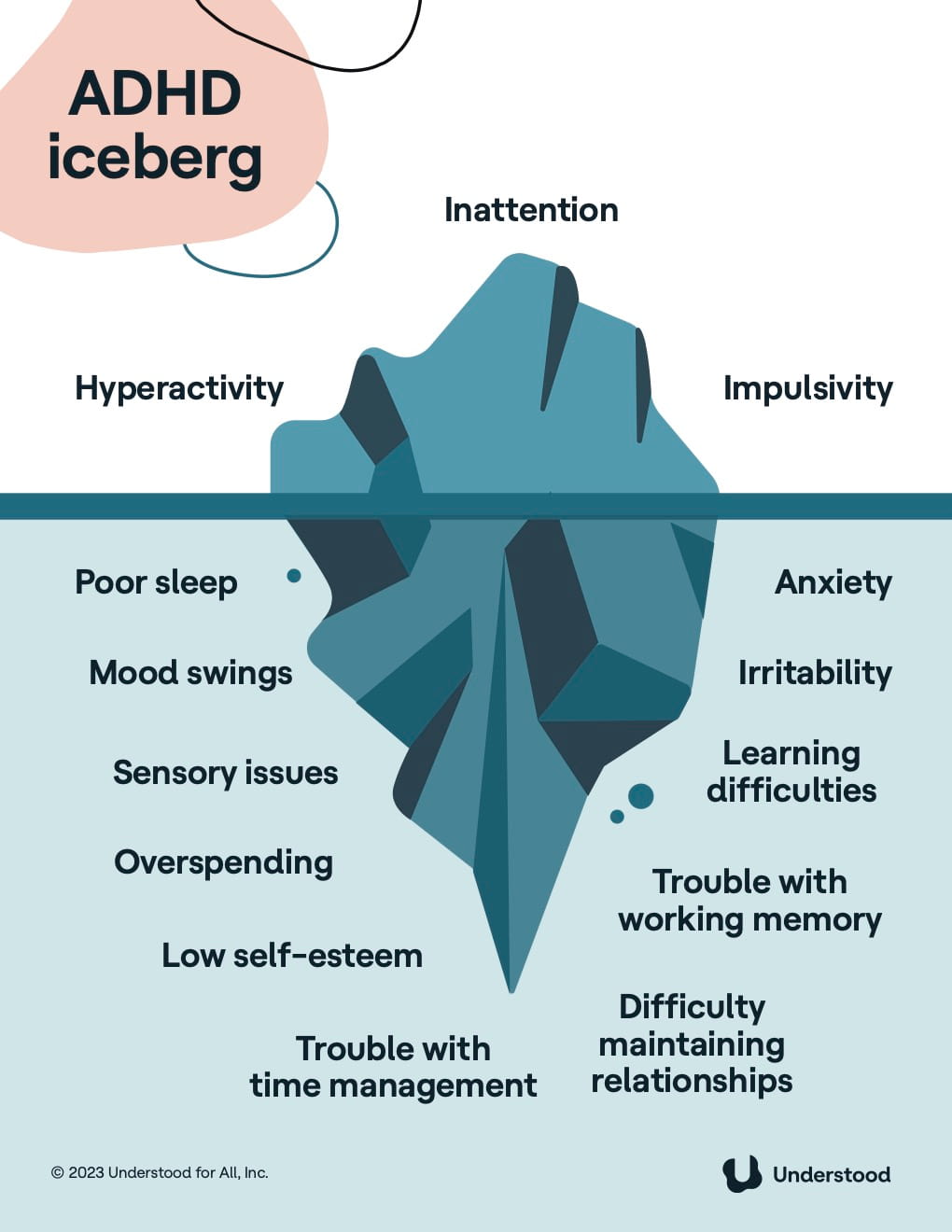
The ADHD Iceberg — what's visible at the surface is only a fraction of what people with ADHD experience. Visual by Understood.org.
- ADHD is a management system problem, not a behavior problem. It has nothing to do with intelligence or willpower.
- People without ADHD can push distracting thoughts aside, but people with ADHD cannot: peripheral thoughts demand attention simultaneously, all the time.
- People with ADHD often have strong long-term memory but struggle with short-term working memory.
- Emotions are often amplified. A frustration that registers as 0–1 out of 10 for most people may register as 7–8 out of 10 for someone with ADHD.
- About 75% of people with ADHD have a close family member who also has it. It's a neurological trait, not the result of poor parenting, bad habits or lack of discipline.
- ADHD often doesn't fully appear until more effort is expected or demanded — in middle school, college or at a first job.
At the same time, people with ADHD can often hyperfocus intensely on tasks they find genuinely interesting — sometimes for hours — while struggling to focus at all on less stimulating work. This isn't a sign of broken development; it's how an ADHD brain works.
Designing For People With ADHD #
At its heart, design guidelines are rooted in respect and consideration for people's needs and ways of experiencing the world. As always, making products more accessible for one group only benefits everybody else as well:
- Remind people about key events and unfinished drafts.
- Display recently opened files, used filters, payments, drafts.
- Improve password recovery: reduce lock-outs and forced log-outs.
- Don't renew contracts without a series of reminders.
- Avoid auto-playing videos and animations (e.g. GIFs).
- Show progress, chunk everything, allow to continue later.
- Prefer a few shorter form pages over one long form page.
- Disclose details, filters, options gradually, not all at once.
- Prefer email reminders over intrusive push notifications.
- Don't make users rely on working memory to complete tasks.
- Proactively show draft/saved items (e.g., "You started writing something last time…").
- Use visual highlights for important numbers, counts, or status indicators.
- Avoid jargon, internal abbreviations, dense business-speak.
- Avoid endless feeds, countdowns and infinite scroll whenever possible.
- Differentiate sections and mark new content, updates and details to be noticed.
The last point is quite often overlooked. As Hayden Bland wrote, the challenge is trying to minimize both déjà vu ("I've already seen this, when I haven't") and jamais vu ("I haven't seen this, when I have"), which is how time blindness can impact scanning and short-term memory operations.
No Human Is "Average" or "Edge Case" #
In design, we often speak about "average" users. That user is a "normalized", average representation of our user base. Most of the time, it represents a neurotypical person with "expected" abilities, views, ways of thinking and decision making.
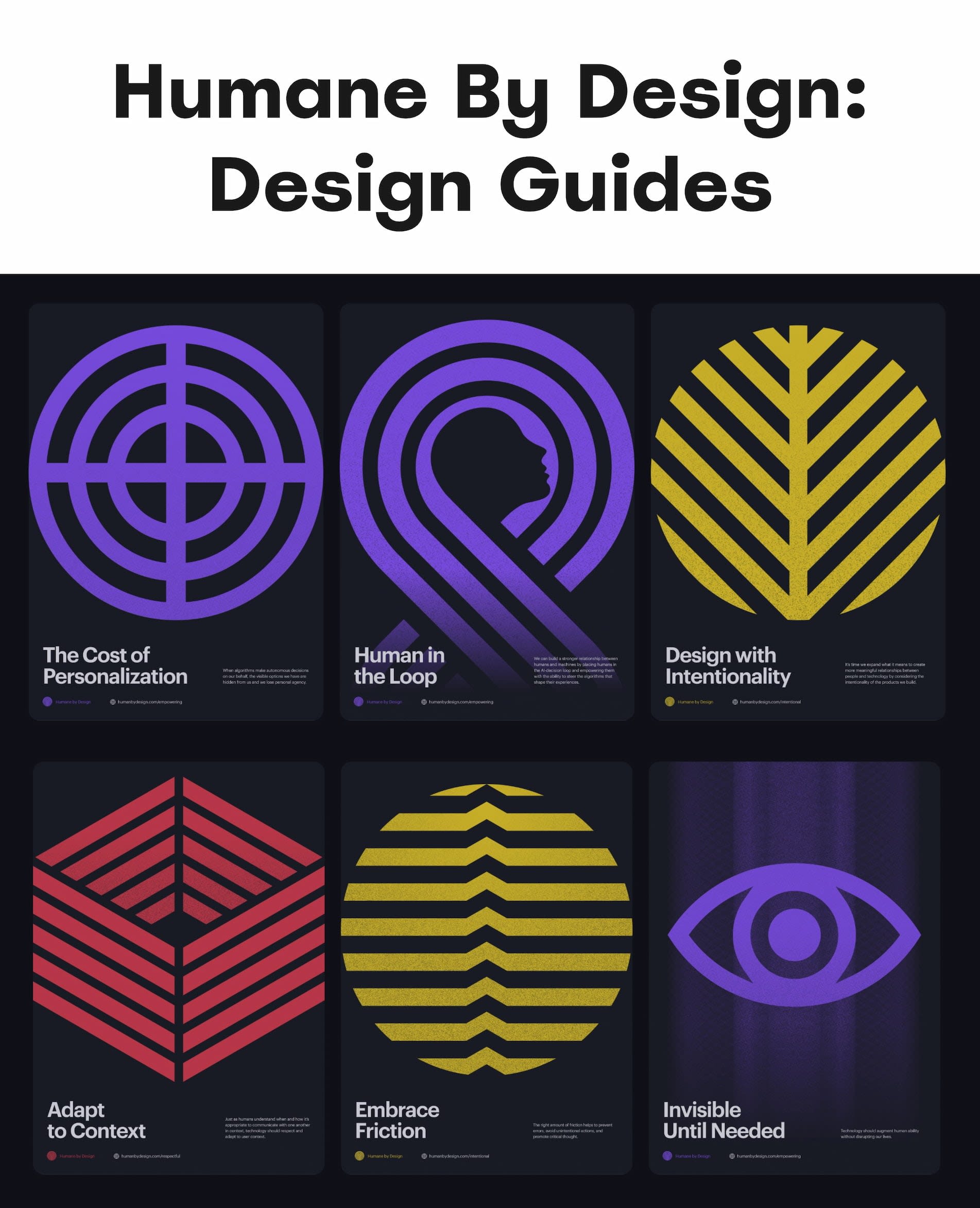
People are simply different people. Humane by Design offers practical principles for building products that respect users' attention, time, and wellbeing — highly relevant to ADHD-aware design.
And most of the time, these people don't exist. There are no "average" users, and no person is an "edge case" either. As designers, our job is to support as many people as possible — along a wide spectrum of abilities and experiences.
ADHD and Autism #
You may have come across the term AuDHD — it refers to people who have both Autism Spectrum Disorder (ASD) and ADHD at the same time. The two conditions often co-occur, and many people don't receive a dual diagnosis until much later in life.
They're different conditions, but they do share some overlapping traits. Here's how Understood.org distinguishes them:
ADHD affects attention, self-control, and executive function. Core symptoms: inattention, hyperactivity, impulsivity. Sensory challenges aren't a defining feature.
ASD (Autism Spectrum Disorder) primarily affects social communication, interaction, flexible thinking. Core symptoms: trouble with communication, restricted interests. Sensory challenges are a key defining feature.
AuDHD = both. Shared traits are intense focus on some interests, sensitivity to sensory input (sounds, light, textures), struggling with social cues and difficulty shifting attention.
The difference matters because AuDHD users may be especially sensitive to busy, noisy, or visually overwhelming experiences — and design choices we make for ADHD tend to benefit AuDHD users significantly as well.
Wrapping Up #
It's worth remembering: many neurodivergent traits typically come with a few other traits at the same time. A user with ADHD may also have dyslexia, anxiety, or ASD. Designing for one often means you're designing for several conditions at once — which is why inclusive design tends to have such a big impact.
Also, each neurodivergent trait comes with unique strengths and challenges. One of the main strengths of neurodivergent people is how imaginative and creative they are, coming up with out-of-the-box ideas quickly — with exceptional levels of attention, strong long-term memory, unique perspective, unbeatable accuracy and a strong sense of justice and fairness.
Neurodivergent skills are superpowers which also require a significant amount of resilience, patience and hard work. Being different in a world that to some degree still doesn't accept these differences is exhausting. So unsurprisingly, neurodivergent people often bring along determination, resilience and high levels of empathy.
Neurodiversity & Inclusive Design Resources #
A wonderful resource that helps us design for cognitive accessibility is Stéphanie Walter's Neurodiversity and UX toolkit. It includes practical guidelines, tools, and resources to better understand and design for dyslexia, dyscalculia, autism, and ADHD.
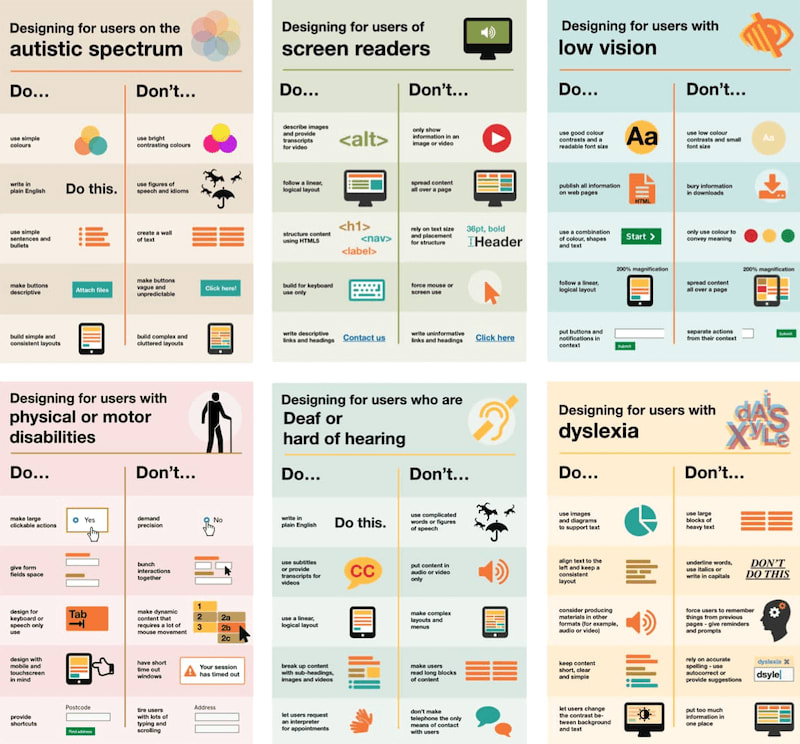
GOV.UK's posters with accessibility dos and don'ts are just one of the many useful resources you'll find in Stéphanie Walter's collection.
Another fantastic resource is Will Soward's Neurodiversity Design System. It combines neurodiversity and user experience design into a set of design standards and principles that you can use to design accessible learning interfaces.
A huge thank-you to everyone who has been writing, speaking, and sharing articles, resources, and toolkits on designing for diversity. The topic is often forgotten and overlooked, but has an incredible impact. 👏🏼👏🏽👏🏾
Useful Resources #
- Software Accessibility For Users With ADHD, by Eva Katharina Wolf, UX Collective
- How My ADHD Makes Me A Better Designer, by Shannon Range, Intuit Design Hub
- What Is ADHD?, by Understood.org
- What Is AuDHD?, by Understood.org
- ADHD Fact Sheet, from Understood.org (accessible PDF)
- Neurodiversity Design System, with design principles and personas informed by neurodiversity
- Writing Small, by Intuit Content Design, tips for concise, accessible UX writing
- Living With Adult ADHD: Explained In Comics, by Ana Krajinovic
- My ADHD Diagnosis Took Nearly 30 Years, by Diamond Sharp
- Building For ADHD Will Make Your Product Better For Everyone, by Penelope, UX Collective
- The ADHD Iceberg, by Understood.org
- Through My Eyes, by Understood.org — first-person perspectives from people with ADHD
- Humane by Design, by Jon Yablonski, with principles for creating technology that respects users' time, attention and wellbeing