No, People Don't Want More AI In Their Life
Many companies assume everyone craves new AI features. But the reality is that most people don't want more AI — at least not in the way most AI leaders envision it.
Many companies silently assume that everybody wants more AI in their lives. That people are craving for new AI features, new AI products, new AI workflows — that would all magically replace all existing outdated practices and broken ways of working.
But in reality, it seems like people don't want more AI at all — at least not in a way of how most AI leaders envision it. Unsurprisingly, many AI features have low adoption and retention — at a very high cost of delivery, and a high risk of reputation damage.
The AI People Don't Need #
It's remarkably difficult to make a strong argument with senior leadership, but AI is not a value proposition. New AI features don't magically make for happy or excited customers. Because AI features are often bolt-ons and separate tools for employees to use, they typically take people out from their regular way of working.
AI is pretty good at amplifying shortcuts and shortcomings in organizations — from data quality to decision making. It can't magically fix years of accumulated quick patches, technical debt, broken culture and internal politics. If anything, they become more visible with AI as inconsistencies or conflicting priorities, and get handed directly to users, who are then left to make sense of the mess themselves.
Because in most organizations, work typically requires hopping on and off between plenty of disconnected and fragmented systems, with a new AI tool, they now have yet another system that they also need to hop on and off. Often it produces more work, and typically it's not a particularly rewarding work either.
On top of that, people are very much aware of the cost of finding and fixing AI hallucinations. Asking AI to generate a response might feel easier than writing from scratch, but it has a cost:
- Skim through the entire AI output
- Spot key points to focus attention on
- Review/verify key points, one-by-one
- Check rationale for what follows next
- Articulate corrections + regenerate
- Review the response (a number of times)
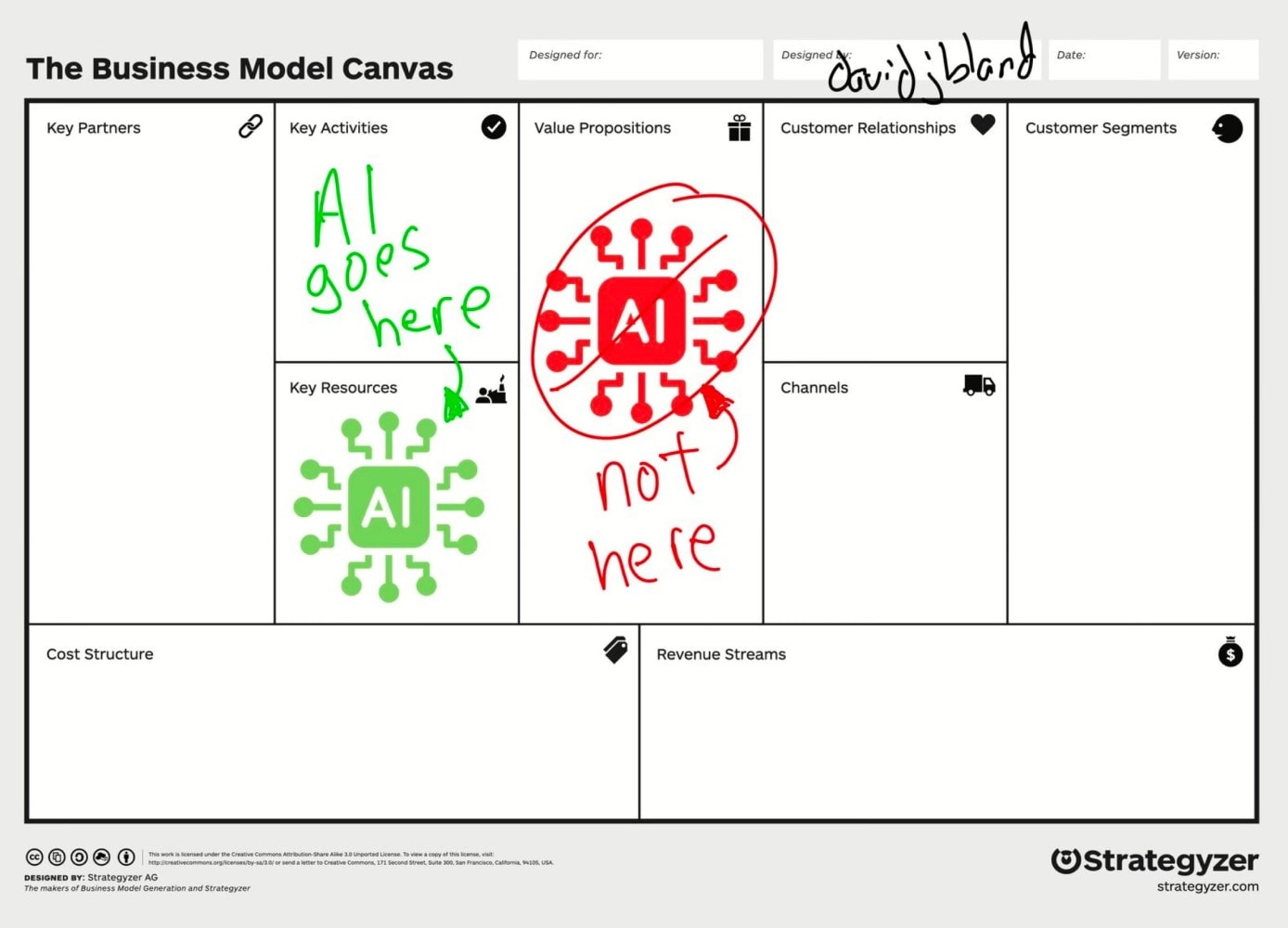
AI goes in Key Activities and Key Resources — not in Value Propositions. Image by David Bland. Large view.
For many people, AI isn't something they can proactively choose and explore on their own — it arrives uninvited, at someone else's pace. On top of that, plenty of messages amplify fears and worries about AI replacing work — so it's hardly surprising that the perception of AI isn't excitement. It's resistance to change and deep anxiety about one's place in a world that seems to be changing without them.
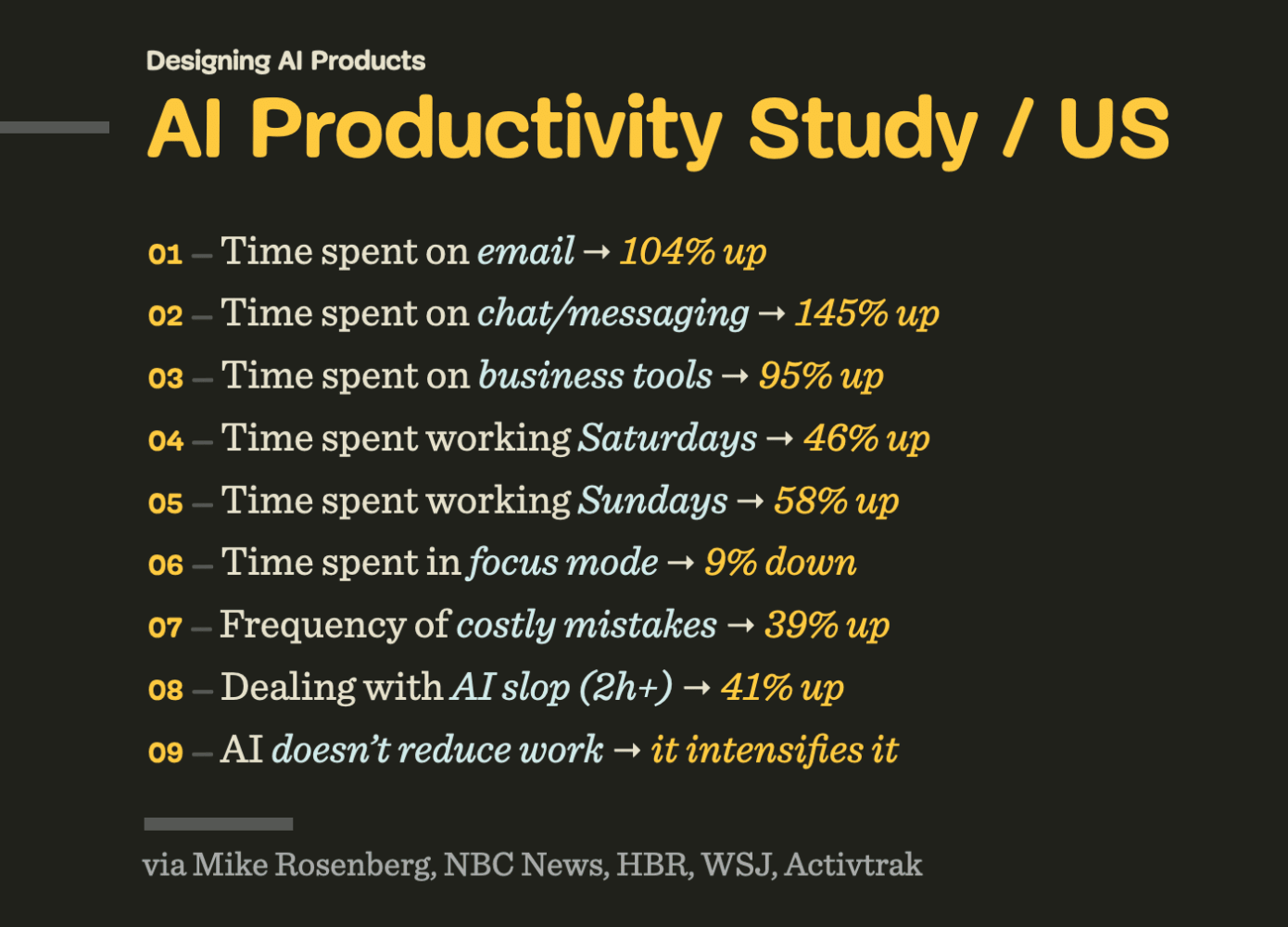
AI Productivity Study findings in the US. Via Mike Rosenberg, NBC News, HBR, WSJ, Activtrak. Large view.
At best, AI features might be silently accepted or nodded away. At worst, AI raises concerns, doubts, caution — and calls for a healthy dose of skepticism. And sometimes it's perceived as a threat or liability — because unlike other features, AI is neither predictable nor reliable.
People don't dream of AI art museums or AI fridges or AI hotel reception or AI-narrated children's books. They don't want their children to have romantic AI partners. Most people don't want to actively manage (and clean up after) a swarm of AI agents roaming in their bank accounts and acting on their behalf in the real world. And most notably, people don't really want a magical box to speak to or type into all the time.
The AI People Actually Need #
I'm always puzzled by the comparison of AI features with how unreliable humans are. But people don't compare software with other people. They compare features with features — and if one feature in one product is unreliable, while a similar feature works flawlessly in another, they choose the latter. It's not about AI or not AI, but rather what works consistently and reliably, and what doesn't.
Many conversations about AI are conversations about speed of delivery. But to many people there is little value in increasing the speed of delivery. They want to do things well, with enough time to think and make good decisions. They also want to enjoy the time they spend working on things, rather than just ship faster. There is an enormous feeling of reward and achievement that slowly disappears, one vibe-coded change at a time.
People don't change much. And after all these years, they (still) want features that are fast, accessible, reliable, predictable and useful — every single time. And ideally not the ones that replace their entire workflow, but that augment their way of working — and that take over the most mundane, annoying and boring tasks that they find no pleasure in.
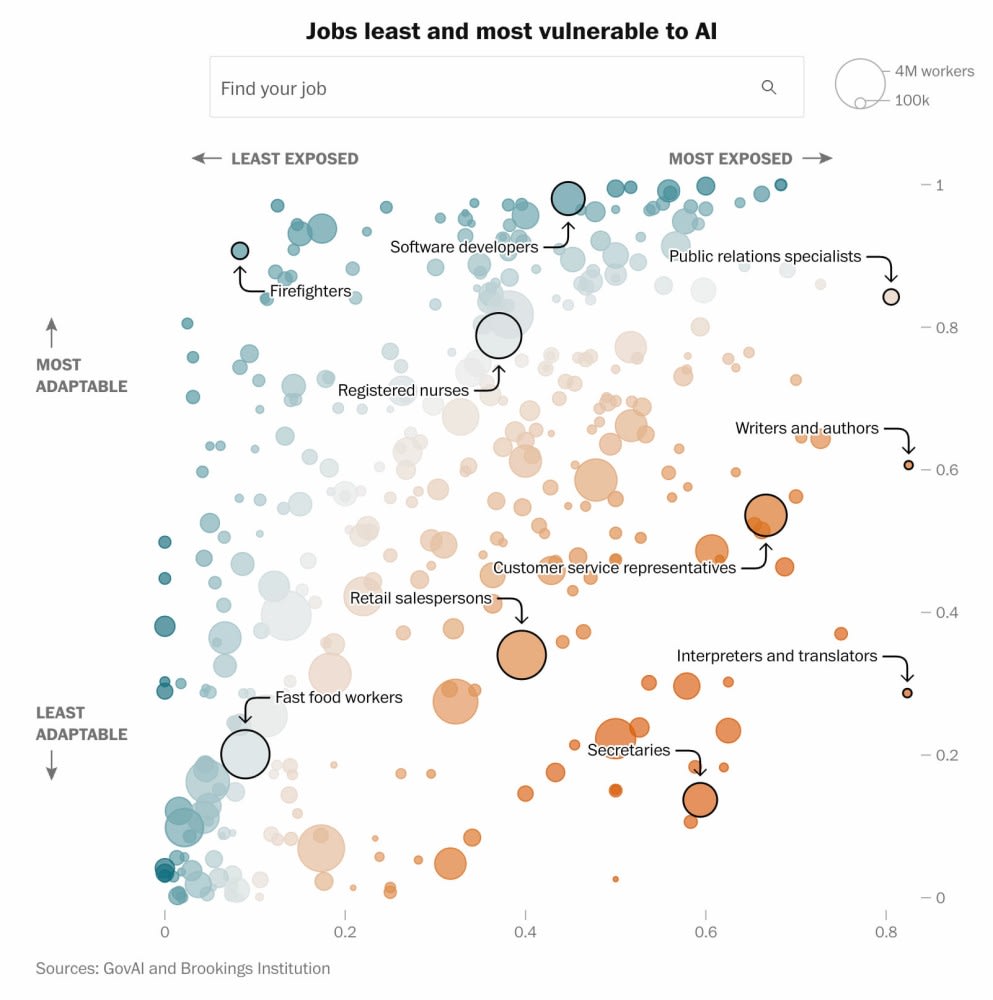
Jobs least and most vulnerable to AI. Sources: GovAI and Brookings Institution, via The Washington Post. Source.
Many jobs are exposed to AI automation, but in many of them there is a rewarding, unique, creative part that requires taste, point of view and perhaps even human intuition. And if AI automates boring parts of it, that's an advantage for everyone. That's also what enhances productivity and brings more joy in daily life.
When AI automates tedious and mentally exhausting tasks, its value is much easier to grasp. But for that, AI shouldn't feel like a bolt-on. It should be deeply integrated into people's existing workflows. It must also match existing mental models that they have developed and fine-tuned for years or decades. AI should adapt to how people think and make decisions, not the other way around.
And it doesn't really matter if these features are branded as "AI", "smart" or "automation". However, they must work well for people using them. And that means that people must be aware of use cases where it actually helps them, and be inspired to find more use cases on their own.
Ironically, tools that work well there aren't "AI-first" — they are "AI-second". Subtle, humble, calm, ambient, taking a supportive role in the background for work that otherwise is remarkably dull and unnecessary.
Bo Young Lee is right when she writes:
“I don't want to read books written by AI. I don't want to gaze upon paintings by AI. I don't want AI to teach my children. I don't want to have an AI therapist. I don't want AI making my medical decisions. I want AI to do all the physical and mental labor that taxes me so I can read books written by humans and go to art galleries to engage with art made by humans. I want AI that makes my life easier rather than force me to change myself.”
Wrapping Up #
Perhaps I'm missing a bigger picture, and perhaps I'm just old school — but I really do like people. Their stories, their thinking, their emotions, their enthusiasm, their laughing. AI can be remarkably helpful in many situations, but so are people. And between the two, I would favor spending time with a human — however imperfect they are — every single time.
No, people don't need more AI in their lives — they need AI to automate all the boring stuff they have to deal with every day, so they have more time and headspace to do things that they actually love and enjoy doing. That doesn't mean spending more time with AI — but spending more time with people they love.
Useful Resources #
- AI Adoption Gap: IBM 2026 Study, by MindStudio
- Powered by AI Is Not a Value Proposition, by Nielsen Norman Group
- AI Chatbots Discourage Error Checking, by Nielsen Norman Group
- The Jobs Most Exposed to AI Automation, by The Washington Post
- On AI and What We Actually Want From It, by Bo Young Lee