How We Brainstorm And Choose UX Ideas
A practical guide on how to run UX ideation sessions with silent brainstorming and 'How Might We' (HMW) statements — by clustering data points into themes, reframing each theme and then prioritizing impactful ideas. The only limits for tomorrow are the doubts we have today.
Many brainstorming sessions are an avalanche of unstructured ideas. They are mostly based on hunches, assumptions and grandiose but impossible ideas.
Just like we need constraints to be intentional in our design decisions, we need structure to mold realistic and viable ideas. But how do we do that? Well, let's figure it out.
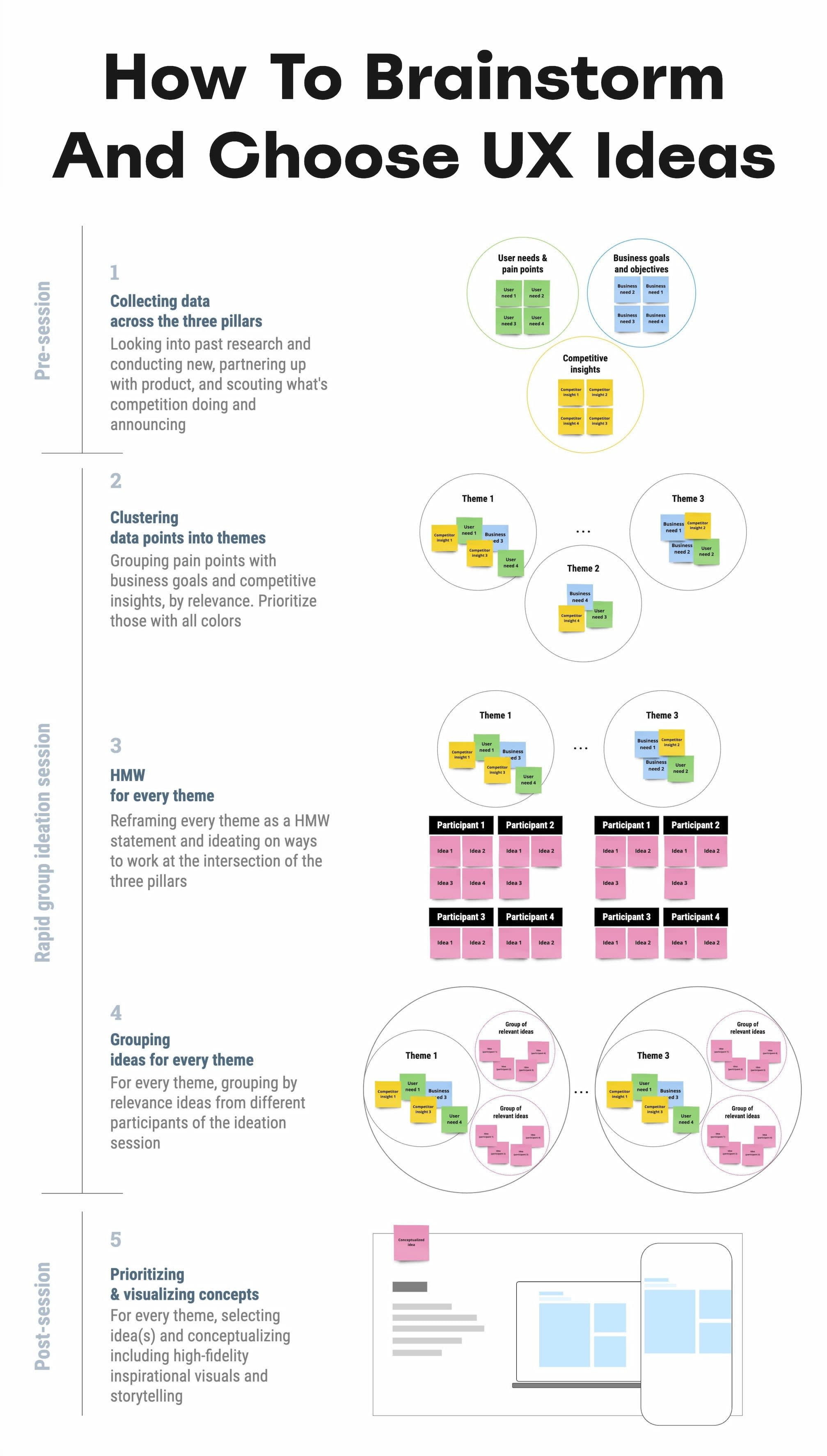
From collecting data to HMW to prioritizing concepts: a detailed visualization of the brainstorming process by Booking.com. Large view.
Giving People Time To Think #
In the messiness of idea generation, we often forget that people need time to think to come up with good ideas. Different people think differently, and they need different amount of time.
Some people think better at home in early mornings, others think best at their workspace, and others just before falling asleep or walking outside. Their ideas can be vastly different and vastly divergent — and that's exactly what we aim for with brainstorming.
Yet in many companies ideation sessions limit these explorations by running collaborative exercises too early.
Silent Brainstorming #
One of the impactful changes I've noticed is just how helpful it is to give people time to think about a problem in silence, on their own, alone with their own thoughts — before jumping into groupthink and collaborative work.
A helpful thing to do is to give people time and space to come up with ideas without enforcing physical or spacial boundaries on them. We could send them an overview of what to brainstorm on ahead of time, along with the context and established goals.
Once everybody has thought about a problem independently, bring all the ideas together. We can then run collaborative exercises to find the direction, and perhaps synthesize ideas or resolve opposite directions. But: we need to see how it might fit in the overall brainstorming format.
Booking.com's Brainstorming Model #
A few years ago I've stumbled upon Booking.com's model to generate ideas more effectively. It's a quite simple process which actually makes ideation slightly more intentional and less chaotic.
- Full Brainstorming Process (PNG)
- Practical guide by Booking.com
- Miro Template, password:
bookingcom
Brainstorming starts with a good preparation. We study past research and gather all relevant data for the following 3 pillars:
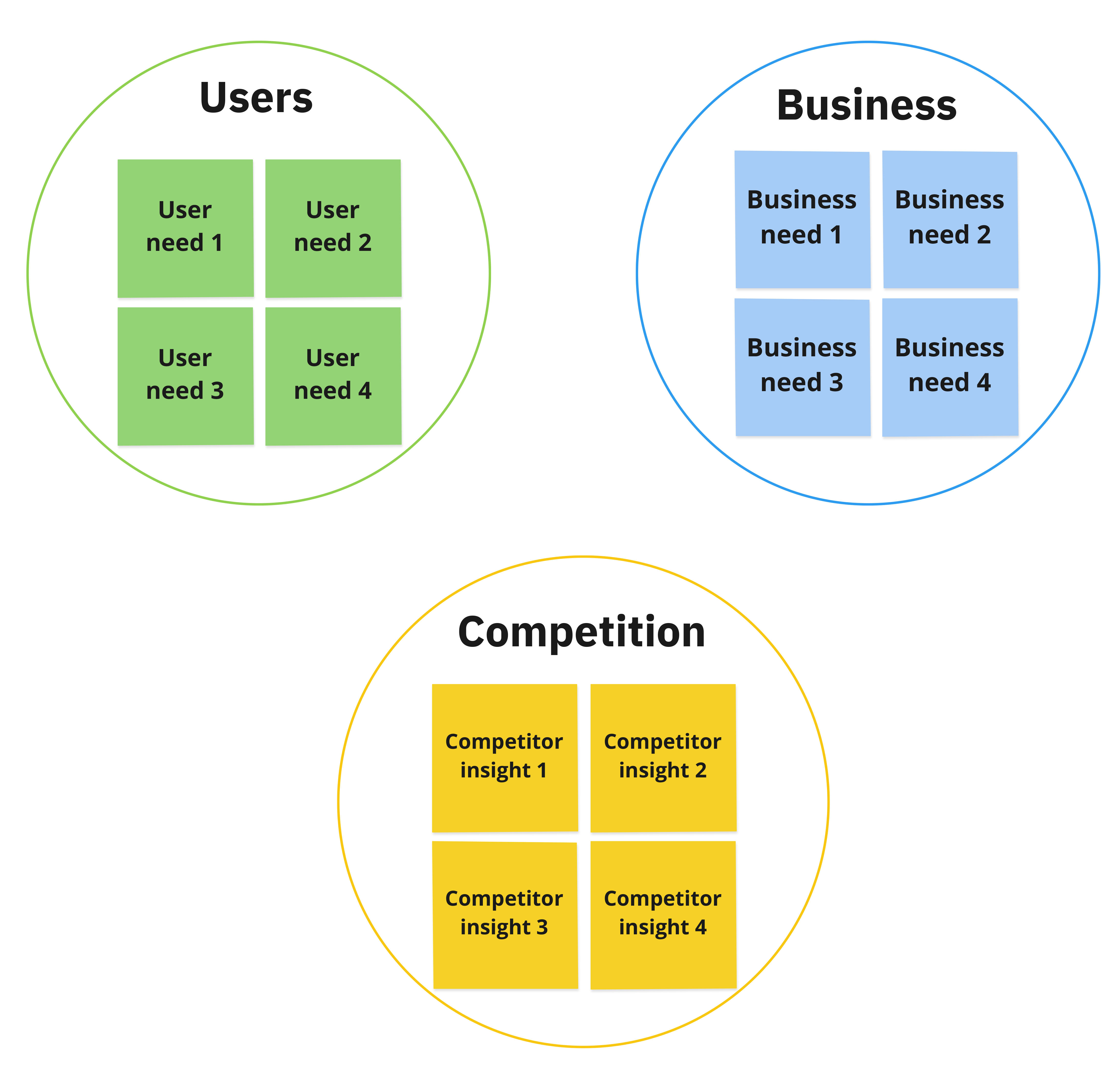
3 pillars of brainstorming: users, business and competition. Large view.
- User pain points and needs
Past research, user needs relevant to the topic. - Business goals and needs
Perspective from PMs, business leaders on main product and business goals. - Competitive landscape
Competitors' features and their product reviews, social media.
All these insights land on a Miro board, with one note per data point and one unique color fo each pillar. It makes sorting and grouping them later much easier.
Once all data points are collected, we send invitations to people who need to be involved in brainstorming — not just designers, but also product, marketing, engineering folks who can contribute relevant insights and perspectives.
Individual Thinking First #
The brainstorming session starts by reiterating context about the problem and the goals. We read all notes, one by one, discuss collected data points and then invite participants to form themes around them silently, independently first.
Personally, I'd love participants to already have them ready, and already have it on the Miro board before the start of the session. But it's useful to give people time to think about it a bit more before moving to ideation.
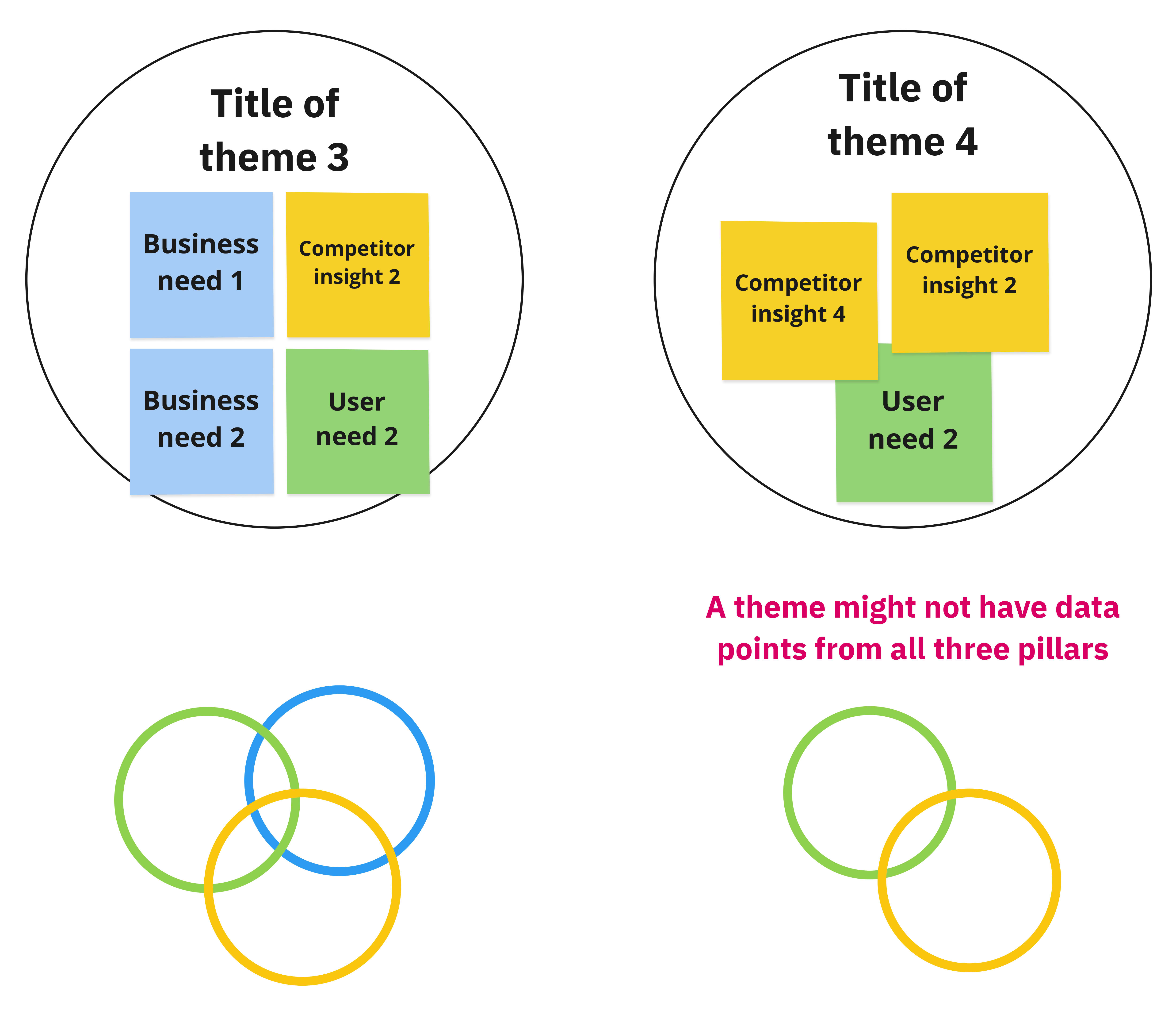
Clustering data points into themes, by relevance. Large view.
Once it's done, we build small groups of 3–4 people max to discuss proposed theme names and where data belongs to. The goal is to have the smallest meaningful number of themes.
How Might We" (HMW) statements #
Next, we could reframe each theme as a "How Might We" (HMW) statement. We start with the problems or insights we've uncovered during your research, and then focus on ideas with desired outcomes, rather than just symptoms.
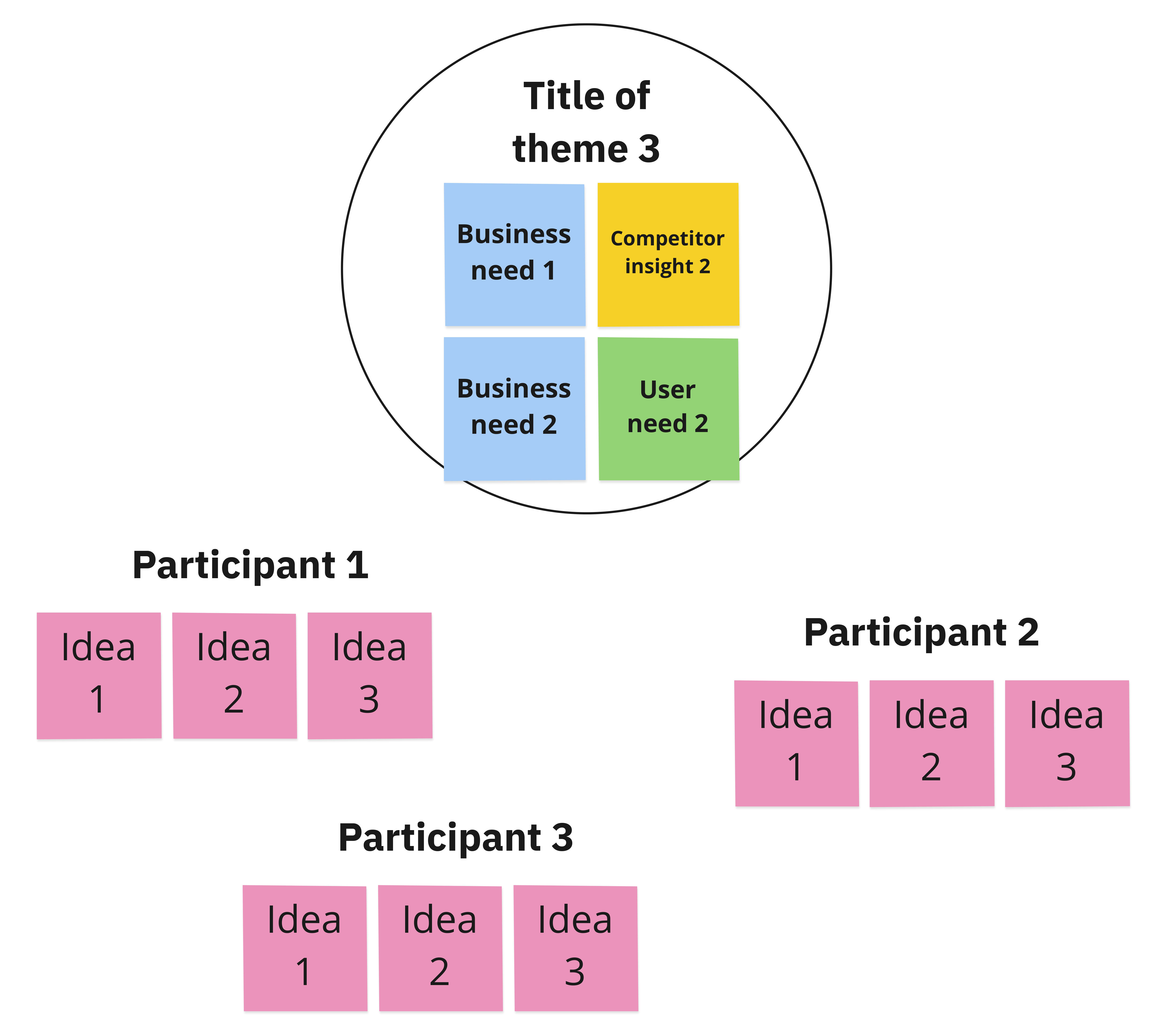
Reframing every theme as a HMW statement and ideating on ways to work at the intersection of the three pillars. Large view.
That's also what participants might already have before the session. But because not everybody will have had the time to complete it, giving time to put it all together, or perhaps explore other themes and other ideas is useful.
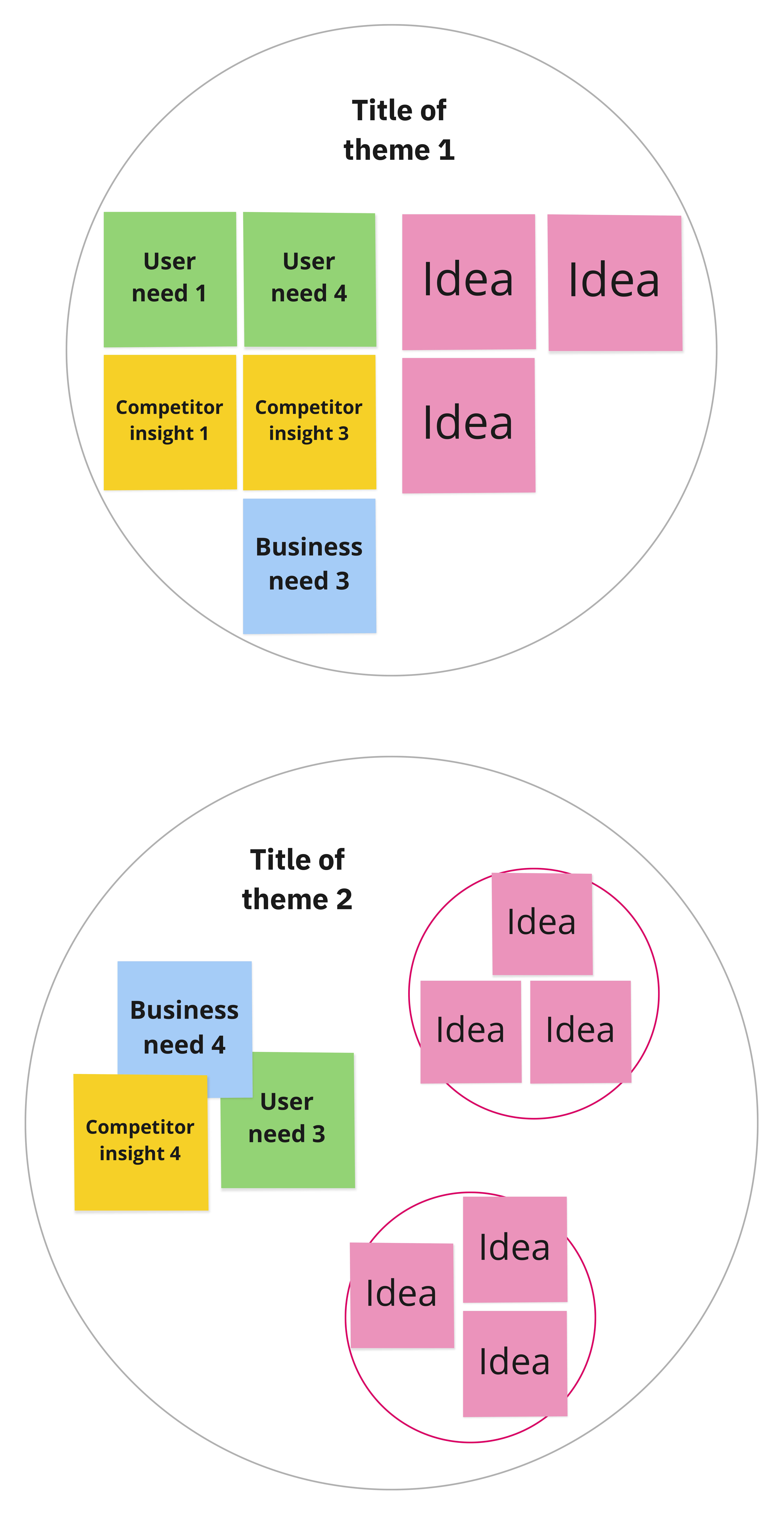
For every theme, grouping by relevance ideas from different participants of the ideation session. Large view.
Then, for every theme, we then collect and group ideas by relevance, prioritize and visualize them. There, using visuals and storyboards helps make complex ideas more accessible and engaging for the whole team.
Sharing and Revising Ideas #
In the end, all participants take turns in sharing their ideas to the group. It also gives time for other participants to build upon what they have been thinking of, and double check if their direction is meaningful to a broader audience.
Some teams build small groups for collaborative revision of ideas, others build groups based on themes they've chosen. However, often ideas get dismissed too quickly, without having a chance to be publicly discussed. Personally, I would go with giving everyone the time to do the work independently, and then present their ideas for discussion.
It's a simple but very helpful approach — without too much rigidity but just enough structure to generate, prioritize and eventually visualize effective ideas with the entire team.
Wrapping Up #
The goal of effective brainstorming is to come up with feasible next steps to pursue. To do that, we need to move beyond assumptions, trying to build ideas upon what we know, rather than what we believe to be true.
Brainstorming often appears chaotic, but it doesn't have to be. Best results come from a workshop that gives people the freedom to think in their own time at their own pace — and in their comfortable space, without biases or self-imposed limitations.
Hopefully, the technique above will help with just that!
Useful Resources #
- "How We Brainstorm And Choose UX Ideas", by Evan Karageorgos, Tori Holmes, Alexandre Benitah (Booking.com)
- Booking.com UX Ideation Template (Miro) (password
bookingcom), by Booking.com - The Rules of Productive Brainstorming, by Slava Shestopalov
- On "How Might We" Questions, by Maria Rosala, NN/g
- Ideation for Everyday Design Challenges, by Aurora Harley, NN/g
- Brainstorming Exercises for Introverts, by Allison Press
- How To Run Successful Product Design Workshops, by Gustavs Cirulis, Cindy Chang
- Edward de Bono's 6 Thinking Hats (PDF Cheatsheet), by Edward de Bono