How To Share NDA-Protected UX Work
When you work in B2B or Enterprise, you typically can't freely speak about a project — not the client, not the findings, not a single screenshot. Here's what a signed NDA usually does (and doesn't) let you share.
When you work in B2B or Enterprise, typically you can't freely speak about a project you've spent years on — not the client, not the findings, not a single screenshot. But how do we show it in a portfolio or use it as a case study in a job interview?
It depends on the specific NDA, but a signed NDA doesn't necessarily mean that you aren't allowed to share anything about the project:
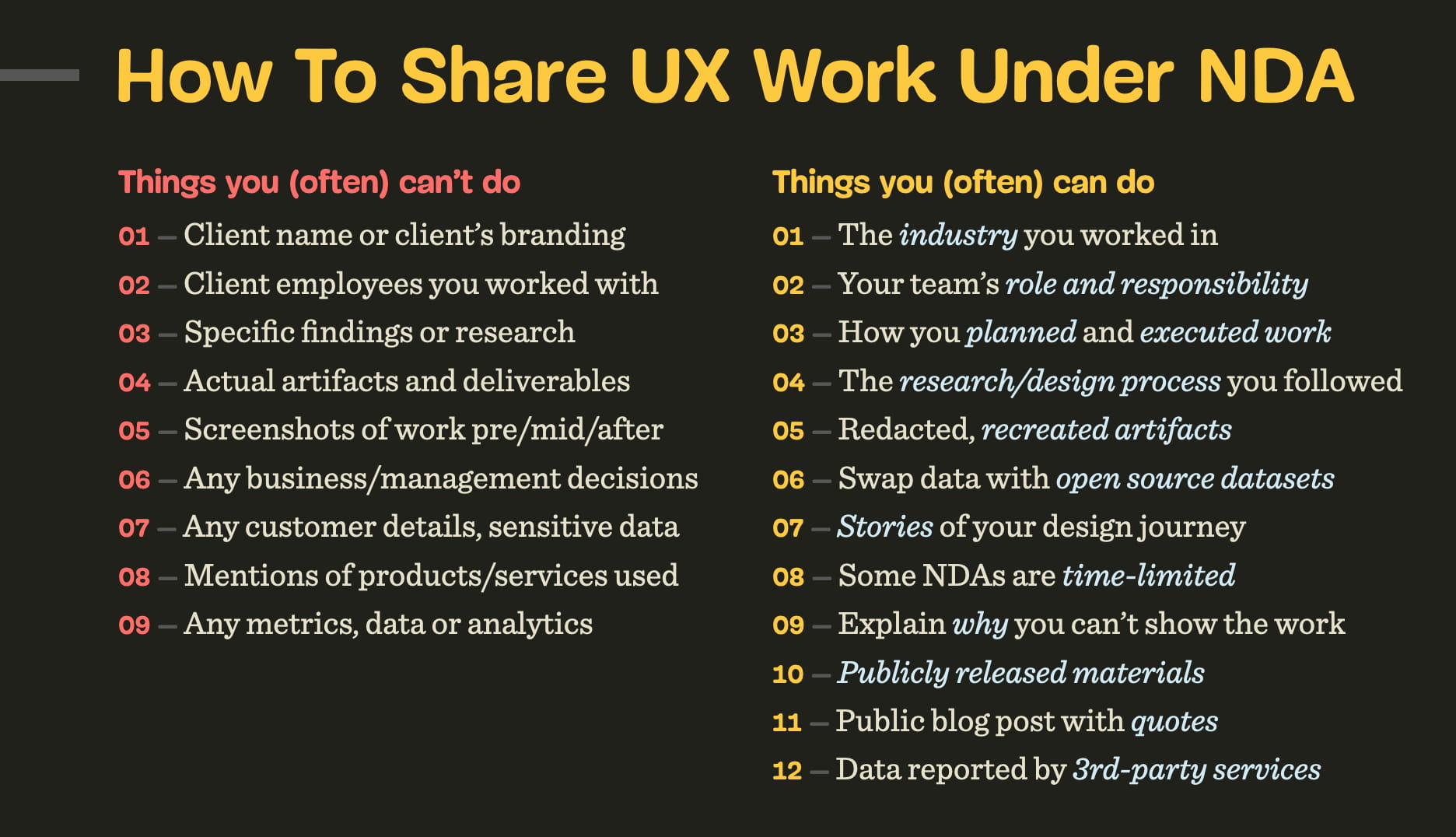
Sharing UX work under NDA: do's and don'ts.
🚫 Things You (Often) Can't Share #
- Client name or client's branding
- Client employees you worked with
- Specific findings or research
- Actual artifacts and deliverables
- Screenshots of work pre/mid/after
- Any business or management decisions
- Customer details, sensitive data
- Mentions of products/services used
- Any metrics, data or analytics
- Vendor or partner names
- Photos from client premises
- Unreleased feature or roadmap details
✅ Things You (Often) Can Share #
- The industry you worked in
- Your team's role and responsibility
- How you planned and executed work
- The research/design process you followed
- Recommendation from your manager/client
- Redacted, recreated artifacts
- Swapped data with open source datasets
- Publicly released materials (press release, YouTube etc.)
- Material from a public talk deck (with cited source)
- Data reported by third-party services (with credit)
In fact, that may include text, screenshots, metrics, quotes from team members or executives — as long as it's already public. Also some NDAs are time-limited, so check how long restrictions actually apply.
Jessica Ivins wrote a useful post on just that a while back. She points out that typically you can't disclose any findings, but you can walk through your methods, your decision-making and how it helped uncover valuable insights or make progress.
As Nick Finck wrote, you don't need to invent numbers — disclose upfront that the case study is under strict NDA, which is why you can't share any specifics. But you can explain your role and your process, and be upfront about what you can't share, and why.
I always struggle with disclosing patterns that emerge from usability testing. Of course, we can't generalize — these findings are often specific to the context we observed them in. But once we introduce a change and notice its impact, that's worth remembering. And because these insights are often perceived as merely technical, I generalize them and ask permission to share — no names, no numbers, no specifics.
What I've found: UX findings rarely feel important to companies, as long as their brand isn't attached and nothing business-critical is revealed through them. It's really a question of how, when and who you ask — and understanding what kind of details is actually OK to make public.
In the end, always check the actual wording of your NDA — don't assume. And when in doubt, ask your manager for permission directly. I hope it helps! 🤞🏽
Useful Legal Documents And Templates For Designers #
A good contract is key to starting a client project off successfully. It sets the right expectations and prevents misunderstandings and, ultimately, potential legal problems. Let's take a closer look at how to create legal documents that protect everyone's interests, as well as handy templates and frameworks you can use right away.
The Professional Association for Design (AIGA) published a comprehensive handbook with everything you need to know to build your own custom legal documents.
Standard Form Of Agreement For Design Work #
A while back, the Professional Association for Design (AIGA) published a comprehensive handbook with everything you need to know to build your own custom legal documents. The guide includes composable contract modules for written agreements around digital design, print, interactive design, motion, and environmental use — with a glossary and a checklist. Kindly created for AIGA by Shel Perkins and Linda Joy Kattwinkel, Esq.
The Ingredients Of A Good Agreement #
To me personally, the crux of a good arrangement is truly understanding and agreeing on the statement of work. I always try to be very deliberate when defining the scope of work, including assumptions, process, commitments, and milestones. Typically it includes:
- This is how we understood your problem.
- This is what the solution requires (breakdown of tasks).
- These are the assumptions that we are making.
- This is how it's going to work (our process).
- This is where and when we'll need your (timely) input.
- These are the milestones and the timeline.
- That's the delivery date we commit to (for that fixed scope).
- That's the total cost of the work.
- Late scope changes are expensive and cause delays.
- All scope changes are estimated and billed separately.
A good contract prevents confusion and protects everyone's interests. As Shel Perkins noted once, you realize just how important this is after you've been burned a few times. Better to be safe than sorry, just in case something unexpected happens.
Legal Document Templates #
The templates below are fantastic starting points to set up your contracts and legal documents — for anything from NDAs to design work to consulting work. You can easily customize and adapt them to your project's scope and needs. Thank you to the fine folks who kindly share them for anyone to use! 👏🏻👏🏽👏🏾
- Legal Docs and Contracts Templates (PDF/Word). A set of contracts for NDA, design work, work-for-hire agreement, consulting work, IP assignment, and sample contracts that we've released a while back on Smashing Magazine.
- AIGA Standard Form Of Agreement For Design Services (PDF). A very thorough handbook with contract modules for written agreements around digital design, print, interactive design, motion, and environmental use — with a glossary and a checklist. Created for AIGA by Shel Perkins and Linda Joy Kattwinkel, Esq.
- Independent Contractor Agreement (PDF). Useful for when you are subcontracting with design firms and ad agencies. By AIGA.
- Contract Template (Figma Kit). A simplified freelance contract for design work. By Kristen Altomare-Ciallella.
- Overdue Invoices, Quote, and Proposal Templates (Figma Kit). A set of Figma templates for invoices, overdue invoices, contracts, project proposals, and quotation. Comes with default text and color styles that can be customized. By Sharanya Dutta.
- Editable Pricing and Packages Quotes (Figma Kit). The Designer's Toolkit includes more than 40 editable documents for designers, among them templates for quotes, design contracts, and pricing and packaging guides. By Andikan Bassey and Elvis Obi.
- Project Proposal and Brief Template (Figma Kit). An easily-editable project proposal template with pages for cover, project intro, pricing, deadlines, and terms and conditions. By Priyank Shah.
- Freelance Contract Template (Figma Kit). A proposal template for freelancers to define their services. Includes work and payment terms, project scope, legal, copyright, and terms and conditions. By Om Arya.